
Principal Scientist
Rhiza Research
Director at Rhiza Research, a non-profit focused on developing open technologies for people and the planet, with a special focus on energy and weather forecasting.

Principal Scientist
Rhiza Research
Director at Rhiza Research, a non-profit focused on developing open technologies for people and the planet, with a special focus on energy and weather forecasting.

Energy Specialist
World Bank
Working on diverse energy sector projects, spanning analytical work and infrastructure project implementation.

Consultant
International Energy Agency
Provided analysis and modeling focused on energy access for the IEA’s battery report; worked with industry and academic experts to build models projecting global battery capacity additions.

Research Scientist
nLine
Developed innovative sensing and data analytics methods to enhance situational awareness, investment targeting, and impact evaluation for electric grids in Sub-Saharan Africa. Collaborated with diverse partners, including academics and utilities, and secured multiple research grants.

Data Team Lead & Power Specialist
PingThings
Led PingThings' data science team to develop transmission monitoring tools leveraging novel high resolution sensors, high performance data storage and access systems, and innovative algorithms for large American utilities. I also led execution and delivery of a large Department of Energy research grant on applications of machine learning for power systems event detection.
Researcher
TERRA-MEPP
Developed image processing algorithms to estimate sorghum biomass from field images collected by a robot, improving efficiency in biofuel development. Participated in field tests at the University of Illinois, Urbana-Champaign, and mentored visiting student researchers from Brazil.

Research Intern
Inscopix
Developed a simulator to generate accurate synthetic microscopic images of neuronal activity, incorporating biological, optical, and imaging process factors. Utilized the simulator to evaluate and optimize image processing algorithms.
I have experience teaching technical topics in energy and computation to a diversity of students, from engineering graduate students to elementary school science teachers. Descriptions of my teaching engagements, and some student testimonials, are provided here.

Electric Power Systems (ER254)
Energy & Resources Group, UC Berkeley
I was the lecturer for this course which provided an engineering introduction to power systems for a diverse cohort of 35 students.
Introduction to Electrical Power Systems (EE137A)
UC Berkeley
Graduate student instructor for Berkeley’s two semester power systems course sequence. Course description:
Overview of conventional electric power conversion and delivery, emphasizing a systemic understanding of the electric grid with primary focus at the transmission level, aimed toward recognizing needs and opportunities for technological innovation. Topics include aspects of a.c. system design, electric generators, components of transmission and distribution systems, power flow analysis, system planning and operation, performance measures, and limitations of legacy technologies.
I led discussion sections, preparing short lectures and interactive exercises. I worked directly with students on challenging topics and answered their questions in weekly office hours. Students consisted primarily of engineering undergraduates and some graduate students pursuing research in the energy space.
Alameda Elementary Environmental Literacy Institute
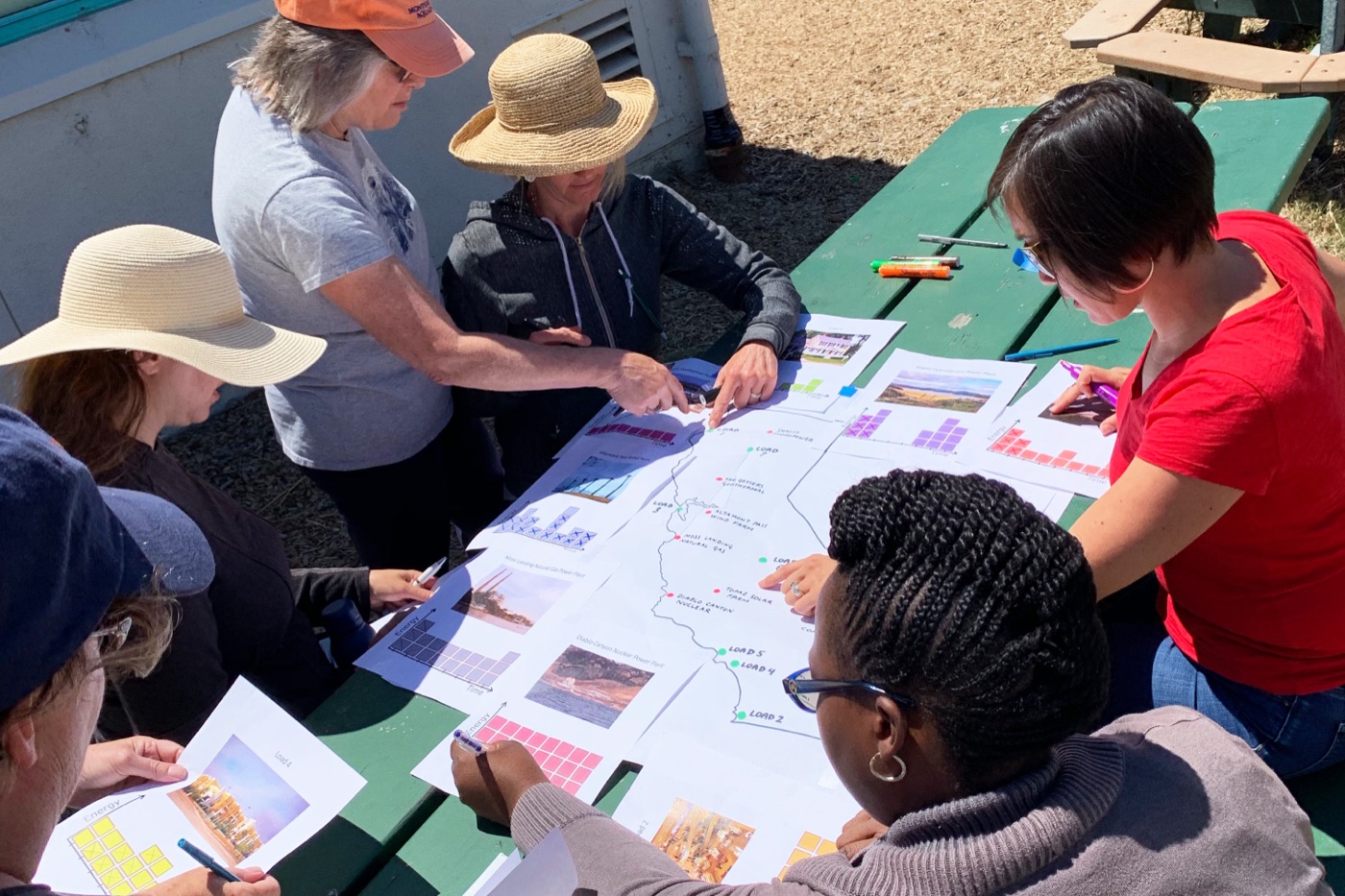
The Alameda Elementary Literacy Institute (AEEL) connects educators with scientists to explore emerging topics in science and engineering, equipping teachers with new content to enrich their classroom curricula. I introduced teachers to the fundamentals of electricity, power generation technologies, and power grids. I developed a variety of activities to communicate key concepts at a level that was accessible and engaging to non-engineers, including short readings, a hands-on activity to develop and test a solar oven, and an interactive game that introduced the challenge of continually balancing power supply and demand in the electric grid.
Introduction to Electrical Power Systems (EE137B)
UC Berkeley
Graduate student instructor for Berkeley’s two semester power systems course sequence. Course description:
Overview of recent and potential future evolution of electric power systems with focus on new and emerging technologies for power conversion and delivery, primarily at the distribution level. Topics include power electronics applications, solar and wind generation, distribution system design and operation, electric energy storage, information management and communications, demand response, and microgrids.
I led discussion sections, preparing short lectures and interactive exercises. I worked directly with students on challenging topics and answered their questions in weekly office hours. Students consisted primarily of engineering undergraduates and some graduate students pursuing research in the energy space.
Solar Design Consultant
Berkeley Town Homes Senior Center
Helped a local senior center consider the costs and benefits of an on-site solar+storage system.
PhD, Electrical Engineering and Computer Science
University of California, Berkeley
Bachelor's, Computer Science
University of California, Berkeley
Samuel Silver Memorial Scholarship
UC Berkeley EECS
Presented annually to an Electrical Engineering or Computer Sciences undergraduate or graduate student who best combines intellectual achievement in science and engineering (in the classroom or in research activities) with serious humanistic and cultural interests. Recipients possess outstanding accomplishments in music, art, and other areas of the humanities.
Berkeley EECS Excellence Award
UC Berkeley EECS
Supplementary graduate fellowship based on outstanding academic performance.